Smoked St Louis Ribs with Apple Cider Glaze
Smoked St Louis ribs, glazed with reduced apple cider in the last thirty minutes of the cook. I made smoked St Louis ribs for a sixtieth birthday BBQ on the first weekend of May at a Newport vacation rental the family had taken for the weekend.
Some links in this post are affiliate links. If you buy through them, I may earn a small commission at no cost to you. I only recommend gear I actually use in my private chef kitchen.
Twenty guests, outdoor patio, the first evening of the season warm enough to keep everyone outside past sunset. The wife had planned the menu around her husband’s favorites. He wanted BBQ. He specifically wanted smoked St Louis ribs with apple cider glaze, the way his dad used to make them. So that’s what I built the table around, along with Carolina pulled pork sliders and hickory smoked chicken thighs, the other two dishes from that same night.
A heads-up before you start: this is a two-day cook. The dry rub needs eight to twenty-four hours in the fridge. The smoke itself runs about five and a half hours. If you’ve never smoked ribs before, this is the right first cook. The wrap stage forgives a lot.
💡 Plan Your Day: Friday 6pm rub the ribs. Saturday 10am pull from the fridge, start the glaze. 11am ribs on the smoker. 2pm wrap. 4pm check doneness and glaze. 4:30pm rest. 4:45pm slice and serve.
Why Smoked St Louis Ribs Work for Private Events
Most rib recipes are written for backyard cooks who want to keep things simple. This one is the opposite. It is built for when ribs are the centerpiece of a private event and they need to read as plated food, not a casual cookout.
The Right Cut for Smoked St Louis Ribs
First, the cut matters. St. Louis-cut ribs are spareribs with the rib tips and breastbone trimmed off. As a result, the cut leaves a clean, even rectangle of meat that takes a dry rub uniformly, smokes evenly, and slices into clean portions for a buffet platter. Baby backs, by contrast, are smaller, faster, and leaner, which sounds easier but actually leaves less margin for error. They overshoot and dry out. Spareribs, meanwhile, are larger but uneven, with thin ends that finish before the thick center is done. Therefore, St. Louis is the cut that scales from a four-person dinner to a twenty-person event without changing technique.
Why the Apple Cider Glaze Beats a Typical BBQ Sauce
Second, the glaze does the work that a typical BBQ sauce can’t. A reduced apple cider glaze concentrates the sweetness of the apple and the acid of the vinegar into a syrup that lacquers onto the bark in the last thirty minutes of the smoke. The lacquer stage is the part where the glaze sets into a sticky, glossy shell. In contrast to tomato-based BBQ sauce, it pulls the smoke flavor forward instead of covering it. The brown sugar in the rub caramelizes underneath, the cider in the glaze sets on top, and as a result the two layers meet to form the sticky mahogany shell you want on a finished rib.
The 3-2-0.5 Method for Smoked St Louis Ribs
Third, the 3-2-0.5 method (three hours of open smoke, two hours wrapped, thirty minutes of glaze-set) gives ribs that hold structure when you pick one up but pull cleanly off the bone with a fork. That is the texture goal. “Fall off the bone” is a marketing phrase. In fact, done-right ribs have tension.
What You Need for Smoked St Louis Ribs
Pork, Rub, and Glaze Pantry
St. Louis-cut pork ribs. Two racks, about three pounds each, for six servings (two to three ribs per person). Whole Foods, Hannaford, and Stop & Shop in the Newport area all keep them in stock through grilling season. If your local store only has baby backs and spareribs, ask the butcher to trim a sparerib rack to St. Louis. Takes about three minutes and almost nobody charges for it.
Light brown sugar. Half a cup, packed, for the rub. Not white, not turbinado, not coconut. Light brown sugar has just enough molasses to caramelize without burning past it. That sweet caramel layer is what builds the bark.
Smoked paprika and sweet paprika. Two different paprikas for depth. The smoked carries the wood note, the sweet rounds it.
Cumin, coriander, cayenne, dry mustard, garlic powder, onion powder, black pepper, kosher salt. The supporting cast. Coriander is the sleeper. Most rib rubs skip it, but it adds a floral, citrus-adjacent note that pulls the apple in the glaze forward.
Unfiltered apple cider. Three-quarters of a cup for the glaze, plus a third of a cup for the spritz. The label should say “cider,” not “juice,” and you should see sediment when you shake the bottle. Unfiltered cider has the apple weight that juice can’t replicate.
Apple cider vinegar. For acid balance in both the glaze and the spritz. Plus Dijon mustard, honey, Worcestershire sauce, red pepper flakes. The glaze finishing notes.
Smoker and Tools for Smoked St Louis Ribs
A pellet smoker that holds 225°F steady for five to six hours. The Weber Smoque XL 34″ pellet smoker is the one I run for private events. Two racks fit flat with room to spare. SmokeBoost mode is useful at the front end when you want extra smoke before the meat seals.
A leave-in probe thermometer. I use the Chef iQ Sense Gen3 wireless probe, two ultra-thin probes, WiFi, monitors temp from the kitchen while I’m prepping the rest of the menu. A $15 instant-read works too if you don’t want to spend on the wireless.
A spray bottle for the spritz. The spritz is the cider-and-vinegar mist you spray on the ribs during the open-smoke phase to keep the surface tacky. The HappyAlley spritzer and brush set is what I keep in the BBQ kit. Comes with a marinade injector, a basting brush, and a stainless spray bottle that doesn’t gum up between cooks.
A small saucepan for the glaze reduction. Pink/peach unwaxed butcher paper or heavy foil for the wrap stage (foil works fine if you only have foil, the bark softens slightly but the meat goes more tender). A squeeze bottle or pastry brush for applying the glaze.
How to Make Smoked St Louis Ribs with Apple Cider Glaze
I got to the Newport rental around eleven that Saturday morning. The patio looked out across a stretch of lawn that ran down to a stone wall, and the host’s wife was already setting cocktail tables along the railing. The smoker was a rental unit the family had brought in for the weekend. I gave it forty-five minutes to come up to temperature while I broke down the ribs in the kitchen.
Pull the Membrane and Rub the Ribs
Pull the Silver Membrane First
The first thing every rib cook needs to do, and the step home cooks skip most often, is pull the silver membrane off the bone side of each rack. The membrane is a thin, tough layer of connective tissue that runs along the bone side. As a result, smoke can’t penetrate it. Rub can’t grip it either. Leave it on and the ribs come out chewy in patches, no matter how good your technique is.
Slide a butter knife or the rounded tip of a paring knife under one corner of the membrane on the bone side of the rack. Then lift it up, get your fingers under it (a paper towel for grip helps a lot), and pull it off in one motion. If it tears, just start again on the remaining piece. Both racks. Five minutes total.
Mix and Apply the Brown Sugar Rub
Now the rub. The night before, I’d made it and rested the ribs in plastic in the refrigerator. The rub itself is straightforward: light brown sugar packed into a bowl, then kosher salt, smoked paprika, sweet paprika, black pepper, garlic powder, onion powder, dry mustard, cumin, cayenne, and ground coriander. Whisk it until the color is uniform brown and there are no clumps.
💡 Lumpy Rub, Uneven Bark: If the brown sugar is clumping, run your fingers through it on a sheet pan first to break it up. Sugar clumps create hot spots on the meat surface where the rub caramelizes unevenly. One pass with your hands fixes it.
Coat both racks generously on both sides with the full half-cup of rub, pressing it into the meat instead of just sprinkling. The side you just pulled the membrane from is the bone side. The other side, the smoother one with more meat coverage, is the meat side. Both sides get rubbed.
Wrapped in plastic, twenty-four hours in the fridge. As a result, the salt pulls moisture from the surface and rebuilds a slightly tacky surface that gives the smoke something to bind to.
💡 Rub Rest Isn’t Optional: Eight hours is the minimum, twenty-four is the target. Skip it and the smoke won’t bind. The ribs come out the color of weak coffee and the flavor sits on the surface instead of penetrating.
Build the Apple Cider Glaze
I made the glaze before the ribs hit the smoke. As a result, it cools and is ready in a squeeze bottle so it goes on smoothly at the final stage.
In a saucepan: apple cider, apple cider vinegar, light brown sugar, honey, Dijon mustard (for emulsion and a back-of-the-throat sharpness), Worcestershire sauce (umami depth), kosher salt, black pepper, and one-eighth teaspoon of red pepper flakes.
Then brought it to a simmer over medium heat. Reduced for about twenty-two minutes, stirring occasionally, until the liquid coated a spoon and pulled a clean line when I dragged a finger through it. The consistency was just thinner than warm maple syrup.
Finally, split the glaze into two bowls. Two-thirds in the main bowl for the smoker brushing stage. Meanwhile, one-third in a separate clean bowl for the final pre-service brush. The smoker-side bowl can sit covered near the smoker. By contrast, the clean bowl goes back in the fridge until about fifteen minutes before service, then warms gently for the final brush.
💡 Split the Glaze Before Brushing: The brush that touches smoker-rib surface should never touch the final-service brush. Splitting the glaze into two bowls is the food-safety move that separates restaurant practice from backyard.
Smoke the Ribs
Pulled the racks from the fridge a full hour before they went on. Cold meat into a hot smoker stalls badly and adds an hour to your cook.
Wood Blend and Smoker Setup
The wood blend I run for smoked St Louis ribs is fifty percent apple, thirty percent cherry, twenty percent hickory. Apple is the dominant note. Softer, sweeter smoke that pairs cleanly with the brown sugar rub and the cider glaze. Cherry, meanwhile, adds depth and pulls a deep mahogany color into the bark. Hickory is the bottom register. For pellet smokers specifically, I shift the ratio to forty percent apple, thirty percent cherry, thirty percent hickory because pellets smoke leaner than offsets and the hickory needs to register on the final bite. As a result, if you only have one type, use what you have. Straight apple works.
Set the smoker to 225°F. 225°F is well under the 320°F threshold where sugar starts to caramelize, so you’re safe with a brown-sugar rub at this temperature. Combined the spritz cider and vinegar (equal parts) in the spray bottle.
Three Hours of Open Smoke
Placed the ribs bone-side down directly on the grates. Smoked three hours, spritzing at the one-hour mark and then every forty-five minutes through the open-smoke stage. The spritz keeps the surface tacky and helps the smoke continue to bind. Therefore, resist the urge to open the lid. Every peek drops the temperature and adds time.
Two Hours Wrapped in Butcher Paper
After three hours, wrapped each rack in butcher paper with about two tablespoons of apple cider inside the wrap. Placed the rack meat-side up in the wrap so the cider pools at the bone side as the rack settles. (Aaron Franklin and Malcolm Reed standard. The bark is fragile after three hours of open smoke and pressing the meat surface into a pool of liquid for two hours softens the crust you just built.) Butcher paper breathes slightly, so the bark stays intact. Foil, by contrast, seals fully, so the meat goes more tender but the bark softens slightly. Both produce excellent ribs.
Doneness Check and the Glaze Lacquer
Cooked two more hours wrapped. Then checked doneness with three cues, in this order: probe slides between bones with no resistance (primary cue), meat has pulled back from the bone tips by about a quarter inch, and internal temp between bones (not touching bone) reads 200°F to 205°F as the backstop. The probe slide is the truth. If you have one tool, that’s it.
💡 Doneness Is a Feeling, Not a Time: The 3-2-0.5 method is a timeline, not a clock. If the probe meets resistance at the two-hour wrap check, return the wrap for another thirty to forty-five minutes. Plan on 5.5 to 6.5 hours total cook time.
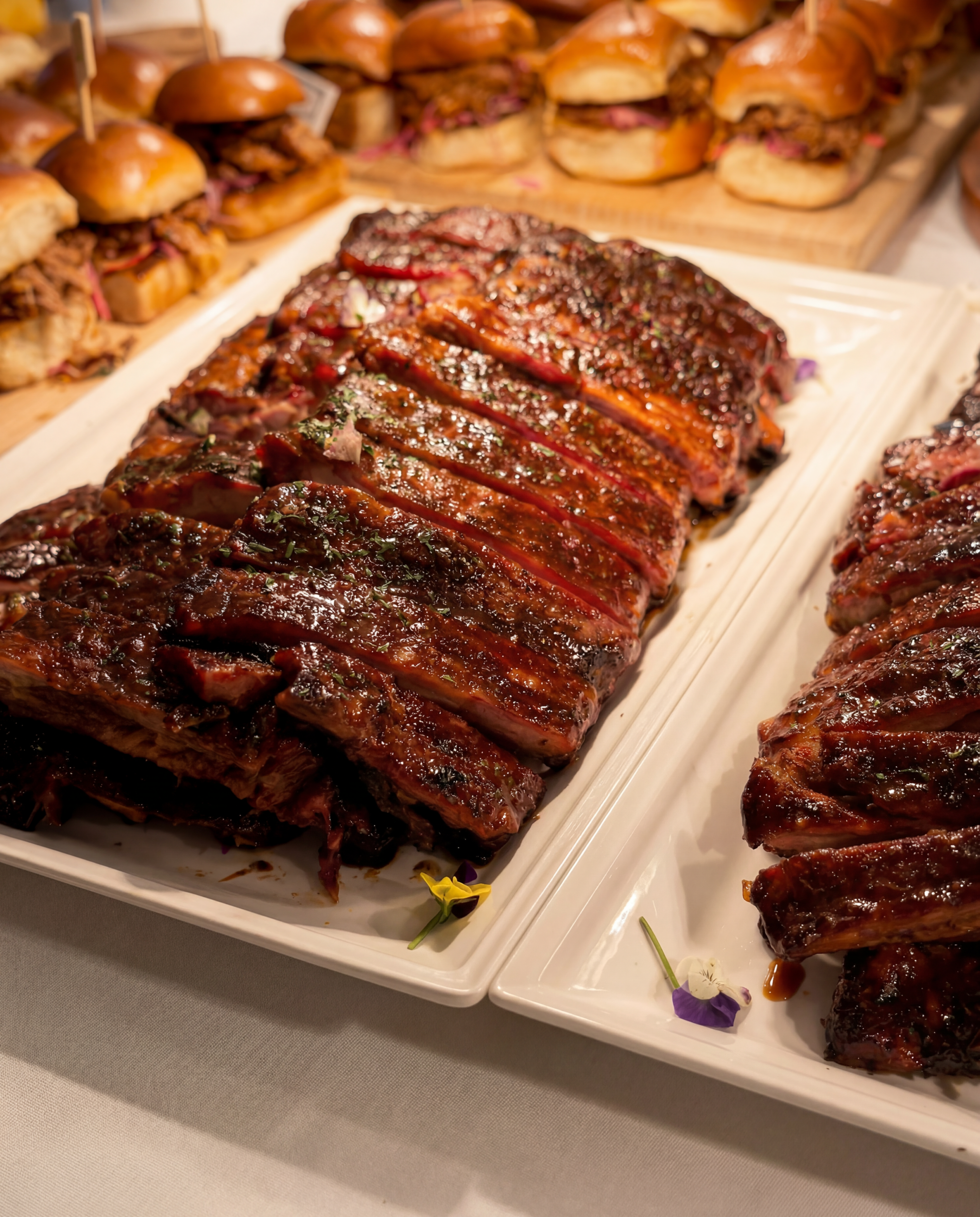
Unwrapped. Brushed both sides liberally with the warmed main-bowl glaze (never the reserved clean bowl). Returned to the smoker, uncovered, for thirty more minutes. As a result, the glaze sets into a sticky, glossy shell, the same shell you see in the photo at the top of this post.
If your smoker creeps above 250°F during the lacquer stage with no spritz moisture, cap it at 235°F. That keeps the brown sugar from edging toward bitter (sucrose starts to break down at 320°F and goes bitter past 350°F, so 235°F is well clear of both).
Rest and Slice
Rested the ribs fifteen minutes off the heat, loosely tented. Twenty minutes is even better if you have it. Slicing too early sends the juices onto the cutting board instead of into your guest’s mouth.
Sliced between the bones. Arranged on a long white ceramic platter in an overlapping fan, glaze-side up. Brushed a thin final coat of the reserved clean-bowl glaze over the top right before service so they were shining when they hit the table. Scattered finely chopped flat-leaf parsley as the only green note, and a few edible flowers (violas, nasturtium) at the corners.
When the host walked out with the platter and set it on the buffet table against the railing, the husband looked at his wife. The wife shrugged like she’d known the whole time he’d love it. He cried a little. Sixtieth birthdays do that.
Chef’s Notes for Smoked St Louis Ribs
Plating
Long white ceramic platter, ribs in overlapping fan arrangement, glaze-side up. Then a final brush of warmed clean-bowl glaze just before service. For garnish, finely chopped flat-leaf parsley and a few edible flowers (violas, nasturtium) at the corners. For home plating, three to four ribs per person on a warmed plate. Don’t crowd. Ribs need room to breathe or they look stacked instead of presented.
Wine and Beverage Pairing
An off-dry German Riesling Kabinett. The residual sugar in the wine matches the glaze, and meanwhile the acid cuts through the rib fat without fighting the smoke. For a red, a cooler-climate Zinfandel from Dry Creek Valley (Ridge Geyserville is the benchmark) holds up better than the jammy high-alcohol Sonoma versions, which clash with the cider acid. For a lighter pour, a chilled Gamay from Beaujolais works against the smoke instead of with it. As an alternative, a malty amber or brown ale, nothing too hoppy.
Prep Ahead
The dry rub holds two weeks airtight. Meanwhile, the glaze holds two days refrigerated; re-warm to brushing consistency. Plan to rub the ribs the day before smoking, minimum eight hours, ideally twenty-four.
Scaling Smoked St Louis Ribs for Service
Each rack of St. Louis-cut ribs serves about two to three guests. For eight people, three racks, multiply rub and glaze by 1.5. To feed twelve, four racks, double the rub and glaze. At twenty (the original event scale), seven racks. Most 22-inch pellet smokers hold three racks flat. For larger counts, batch by three and stagger starts by ninety minutes so the second batch finishes during the plating window.
Hold finished racks wrapped tight in foil at 170°F for a maximum of two hours before texture starts to fail (the meat continues to cook past the 200 to 205°F done window). For longer holds up to four hours, drop the oven to 150 to 160°F.
Glaze reduction time does NOT scale linearly. As a result, five times the recipe in a four-quart saucepan takes thirty-five to forty minutes instead of twenty. Use a wider, shallower pan to keep reduction time controlled. Cut to order if you can. Pre-cut racks lose about thirty percent of their glaze gloss within fifteen minutes. If you’re planning a full event around this, the Dinner Party Dossier walks the full timing and staging playbook for 8 to 20 person dinners.
Swaps and Substitutions
Baby back ribs work but cook faster, so cut total time by an hour. In contrast, spareribs add an hour to the wrap stage. The wood blend can flex, with peach or pecan as apple substitutes, but never mesquite (too aggressive for this glaze). If you only have foil and no butcher paper, foil works. As a result, the bark softens slightly but the meat goes more tender. For a different sauce direction entirely, the chimichurri sauce recipe also works as a finishing brush on ribs if you want bright herbs over sweet glaze. Similarly, the filet mignon with apple brandy glaze is the closest cousin in the archive, same glaze-and-rest technique, different protein.
If you cooked this, hit reply and tell me how the bark came out. As a result, that’s the part I want to hear about. Meanwhile, I read every email.
Want the next two recipes from this same Newport BBQ (the Carolina pulled pork sliders and the hickory smoked chicken thighs)? Sign up for Recipe Drops. One recipe a week from a real Partum Events event, straight to your inbox.
Planning your own dinner party? The Dinner Party Dossier is the staging playbook I use for 8 to 20 person events. Timing, prep order, the small details that hold a night together.
Hosting at a Newport rental and want me to run it instead of you? Partum Events books private chef BBQs through the summer.
Case No. 027
[WPRM_SHORTCODE_HERE]
Case No. 027
St. Louis Ribs with Apple Cider Glaze
Ingredients
Method
- Pat each rack of ribs completely dry. Slide a butter knife or the rounded tip of a paring knife under the silver membrane on the bone side. Lift it, get your fingers under it with a paper towel for grip, and pull it off in one motion. Both racks.
- Whisk brown sugar, kosher salt, smoked paprika, sweet paprika, black pepper, garlic powder, onion powder, dry mustard, cumin, cayenne, and coriander in a bowl until uniform and clump-free.
- Coat each rack generously with the full half-cup of dry rub on both sides, pressing it firmly into the meat. Wrap tightly in plastic and refrigerate 8 to 24 hours.
- Pull the ribs from the fridge a full hour before they go on the smoker.
- Combine apple cider, apple cider vinegar, brown sugar, honey, Dijon, Worcestershire, salt, pepper, and red pepper flakes in a small saucepan.
- Bring to a simmer over medium heat. Reduce 20 to 25 minutes until glossy and slightly thickened, the consistency of warm maple syrup. It should coat a spoon and pull a clean line when you drag a finger through it.
- Split the glaze into two bowls: two-thirds in the main bowl for smoker brushing, one-third in a separate clean bowl for the final pre-service brush. Refrigerate the clean bowl, leave the smoker-side bowl covered near the smoker.
- Heat smoker to 225°F. Use a pellet or chunk blend of 50% apple, 30% cherry, 20% hickory. For pellet smokers specifically: 40/30/30 for stronger smoke registration. Combine spritz cider and vinegar in a spray bottle.
- Place ribs bone-side down directly on the grates. Smoke 3 hours, spritzing at the 1-hour mark and then every 45 minutes through the open-smoke stage. Resist opening the lid. Every peek adds time.
- Wrap each rack meat-side UP in butcher paper or heavy foil with about 2 tablespoons of apple cider splashed at the bone side. Return to the smoker for 2 more hours.
- Check doneness with three cues in this order: (1) probe slides between bones with no resistance, primary cue; (2) meat has pulled back from bone tips by about 1/4 inch; (3) internal temp between bones, not touching bone, reads 200 to 205°F as backstop. If resistance remains, return wrapped for 30 to 45 more minutes. Plan on 5.5 to 6.5 hours total cook time.
- Unwrap. Brush both sides liberally with the warmed main-bowl glaze (never the reserved clean bowl). Return to the smoker uncovered for 30 minutes to set the glaze into a sticky lacquer. If smoker creeps above 250°F with no spritz moisture, cap it at 235°F.
- Rest the ribs 15 to 20 minutes off the heat, loosely tented, before slicing between the bones.
- Slice between the bones. Arrange in an overlapping fan on a long white ceramic platter, glaze-side up.
- Brush with the reserved clean-bowl glaze just before serving. Garnish with finely chopped flat-leaf parsley and a few edible flowers at the corners.
Notes
Evidence File
Loved this? The Evidence File has 3 more just like it.
A downloadable date-night menu from my private chef archive. Three courses, timed for a home kitchen, plated like the real thing.
Open the Evidence File — $14Did You Make This?
Rate this recipe.
If this recipe made it to your table, tap a star. It helps other home cooks find it.
Classified Access
Get the recipes before they’re public.
New case files. Chef’s notes. The stuff I don’t post anywhere else. Delivered weekly.