Hickory Smoked Chicken Thighs Recipe
The hickory goes in the rub, not in the smoke. That is the trick.
Some links in this post are affiliate links. If you buy through them, I may earn a small commission at no cost to you. I only recommend gear I actually use in my private chef kitchen.
Hickory smoked chicken thighs are the BBQ dish home cooks ruin most often, and the failure mode is almost always the same. They pile hickory pellets in the smoker, hoping for that deep Southern BBQ flavor, and the chicken comes out bitter, acrid, with a rubbery skin nobody wants to eat. The fix is putting the hickory backbone in the dry rub via smoked paprika, and keeping the smoke wood gentle. Cherry and apple. No hickory in the smoker.
I served these at a sixtieth birthday BBQ on the first weekend of May at a Newport vacation rental the family had taken for the weekend. Twenty guests, outdoor patio, the lighter protein on a table that was otherwise about red meat. The wife had planned the menu around her husband’s favorite dishes, and he wanted BBQ. So I built the spread around three: St. Louis ribs with apple cider glaze as the centerpiece, Carolina pulled pork sliders for cocktail hour, and these chicken thighs for the guests who wanted something other than pork.
This is a same-day cook, not a two-day project. The pickled onion goes on Friday afternoon (it needs at least two hours to mellow). Four hours of rub rest in the fridge Saturday morning, two hours on the smoker, and you eat. The right entry point if you have a smoker and you are not ready to commit to a twelve-hour pork shoulder yet.
💡 Plan Your Day: Friday afternoon pickle the red onion (minimum 2 hours, overnight is better). Friday night or Saturday morning rub the thighs and rest in the fridge. Saturday 2:30pm smoker on, comes up to temp by ~2:50pm (most pellet smokers hit 250°F in 15 to 20 minutes). 3pm thighs on the smoker. 4:30 to 4:45pm internal hits 175°F. Bump to 400°F for 5 to 7 minutes to crisp the skin. 4:55pm rest 5 minutes. 5pm serve.
Why This Hickory Smoked Chicken Thighs Recipe Works
The Wood Mistake Most Smoked Chicken Thighs Recipes Make
Most smoked chicken thigh recipes get the wood wrong. They pile on hickory or mesquite at the smoker, hoping for that deep Southern BBQ flavor. What they get instead is bitter, acrid chicken with a rubbery skin. In fact, chicken absorbs smoke twice as fast as pork or beef, and a one and a half to two hour cook on aggressive wood pushes past the point where smoke flavors meat and into the point where smoke ruins it. The same hickory load that gives a 12-hour pork shoulder its deep mahogany bark turns a 2-hour chicken thigh into something that tastes like an ashtray.
Hickory in the Rub, Cherry and Apple in the Smoke
The fix is putting the hickory backbone in the rub. Smoked paprika gives you the wood backbone in dry form, applied directly to the meat. Two paprikas actually, smoked and sweet, for depth. Then the actual smoke wood goes light. Cherry and apple. Cherry adds color and depth, meanwhile apple keeps the smoke clean. As a result, the chicken picks up just enough smoke to be smoke-flavored, not smoke-dominated. The hickory taste is there, applied by spice, not by wood.
Why Hickory Smoked Chicken Thighs Need 175°F, Not 165°F
The internal temperature target is 175°F, not the standard 165°F. This is the single move that separates BBQ-pit smoked thighs from grocery-store roasted thighs. Chicken thighs are dark meat with connective tissue running through them. At 165°F the meat is safe but the collagen has not rendered, and consequently the texture is rubbery. However, at 175°F to 200°F the collagen breaks down, the fat renders, and the meat is silky. This is the same logic as cooking ribs to 200°F. Dark meat with connective tissue wants higher internal than lean white meat. In contrast, white meat (chicken breast) dries out past 165°F. Dark meat needs to push further.
Skin Crisp and Pickled Red Onion Finish
The skin needs a finishing move. Two hours at 250°F gives you smoked meat but flabby skin. A blast at 400°F for the last five to seven minutes crisps the skin without overcooking the meat. Alternatively, finish skin-side down on a hot grill or under a broiler. Either way, do not skip this step. Soft skin on smoked chicken is the failure mode home cooks complain about most.
The pickled red onion is the bright counter to the warm smoke. Acid, color, contrast. Onion goes from sharp to sweet in two hours of brine. As a result, by dinner the onion is mellow, ruby-pink, and ready to scatter generously over the thighs right before service.
What You Need for Hickory Smoked Chicken Thighs
Chicken and the Hickory Rub Pantry
Bone-in, skin-on chicken thighs. Six thighs for six servings, about two pounds total. Bone-in for moisture retention and structure. Skin-on for the finishing crisp. In contrast, boneless skinless thighs cook in half the time and the skin you would have crisped is gone. Not the right cut for this dish.
Light brown sugar, kosher salt, smoked paprika, sweet paprika, black pepper, garlic powder, onion powder, dry mustard, cumin, cayenne, coriander, celery seed. The hickory rub. Two paprikas for depth: smoked carries the wood note that replaces actual hickory smoke, while sweet rounds it out. Celery seed is the sleeper here. It adds a subtle floral note that pulls forward against the smoke.
Olive oil. Two teaspoons, brushed lightly on each thigh before the rub. The oil helps the rub adhere and keeps the surface from drying during the cook. On a two-hour cook the oil does not block smoke binding the way it would on a long pork shoulder cook.
Pickled Red Onion Ingredients
Red onion. A 4 oz red onion, sliced thin (about 1/8 inch, or the #2 setting on a mandoline) for the pickle. Buy them firm and heavy for their size. However, bulk-store onions with green sprouts in the center will pickle bitter.
Apple cider vinegar, sugar, salt, black peppercorns, bay leaf. The pickling brine.
Smoker and Tools for Hickory Smoked Chicken Thighs
A pellet smoker that holds 250°F steady for two hours AND can bump to 400°F for the final skin crisp. Verify your smoker hits 400°F before you start. Cheap pellet smokers cap at 350°F, which will not crisp chicken skin. As a result, if your smoker tops out below 400°F, plan to finish the thighs skin-side down on a hot grill or under a high broiler instead. The Weber Smoque XL 34″ pellet smoker is what I run for private events. The PID temperature control matters here. In addition, cheap pellet smokers can swing 30°F on the bump from 250°F to 400°F, and that swing is what ruins the skin.
A leave-in probe thermometer. Chicken thighs at 175°F internal is precise. The Chef iQ Sense Gen3 wireless probe lets you monitor without opening the lid every fifteen minutes. A $15 instant-read works if you check at the 90-minute mark and every ten minutes after.
A basting brush. Not for spritzing (this recipe has no spritz step), but for the olive oil application before the rub and for any post-smoke glaze finishing you might want to add. The HappyAlley spritzer and brush set includes a basting brush that I use across the BBQ kit.
A pint or 1-quart heatproof jar or container for the pickled red onion. A sheet pan and wire rack for resting the thighs after rubbing.
How to Make Hickory Smoked Chicken Thighs
I started the pickled onions Friday afternoon. The brine needs a minimum of two hours to mellow the raw onion, and overnight is even better. By Saturday morning the onions were ruby-pink, sliced thin, and tasted of sweet-tart cider rather than raw allium burn.
Pickle the Red Onion (Friday afternoon)
Pack the sliced red onion into a pint or 1-quart heatproof jar, pressing down to fit.
In a saucepan, bring apple cider vinegar, water, sugar, salt, peppercorns, and a bay leaf to a simmer. Whisk until sugar and salt fully dissolve.
Pour the hot brine over the onions. Press them down with a spoon so they are fully submerged. Then cool to room temperature, then refrigerate at least two hours, ideally overnight. In addition, the pickled onions keep two weeks in the fridge.
💡 Brine the Onion First: The pickled onion is the only thing in this recipe that needs time. Make it before you rub the thighs. The minimum is 2 hours but overnight is better, and they will be the brightest pop of color on the platter when you serve.
Rub the Chicken Thighs (Saturday morning)
Whisk brown sugar, kosher salt, smoked paprika, sweet paprika, black pepper, garlic powder, onion powder, dry mustard, cumin, cayenne, coriander, and celery seed in a bowl until evenly combined.
Pat the thighs completely dry with paper towels. Wet skin will not crisp. Trim any large flaps of excess skin or loose fat at the edges, but keep the skin intact across the meat.
Brush each thigh lightly with olive oil on both sides. The oil is for rub adhesion and surface moisture, not flavor.
Season generously with the hickory rub on both sides, lifting the skin where possible to season the meat directly underneath. Chicken thigh skin is attached at the edges but loose across the center, like a flap. Slide your fingers under the center pocket and rub the spice mixture directly on the meat. This step is what separates great smoked chicken from average smoked chicken. However, most home cooks season the skin and stop. Season under the skin and the meat itself picks up the rub. Plan on about one teaspoon of rub per thigh on the outside, plus another half teaspoon under the skin.
💡 Season Under the Skin: Loosen the center skin pocket with your fingers and rub the spice mixture directly on the meat. The skin acts as a flavor blanket during the cook, and you end up tasting hickory in the meat, not just on the surface.
Arrange on a sheet pan skin-side up, cover loosely, and refrigerate at least four hours, ideally overnight. The rest lets the rub set into the skin and the salt draw moisture out and back in, seasoning the meat all the way through.
Smoke the Thighs (Saturday afternoon)
Heat the smoker to 250°F. Wood blend: sixty percent cherry, forty percent apple. No pure hickory wood. The hickory backbone is already in the rub.
Place the thighs skin-side up directly on the grates with about two inches of space between each. As a result, crowding causes uneven cooking and pale skin on the bottom thighs.
Smoke one and a half to two hours, until the internal temperature at the thickest part of the thigh (not touching bone, which would read hotter and trick you into pulling early) reads 175°F. This is the critical number. Most chicken safety charts say 165°F, but dark meat with connective tissue needs to push past that to render the collagen and turn silky. 175°F to 200°F is the texture window. Below 175°F and the meat is safe but rubbery. In contrast, above 200°F and it starts to dry out.
💡 Chicken Thighs Want 175°F, Not 165°F: This is the single move that separates BBQ-pit smoked thighs from grocery-store roasted thighs. Connective tissue in dark meat does not break down until past 165°F. Pull at 175°F and the meat is silky, the fat is rendered, the bite is correct.
If a probe reads 175°F before the 90-minute mark, the thighs were smaller than expected or your smoker is running hot. Pull them. The texture window is forgiving up to about 200°F, so a few extra degrees from carryover during the skin crisp is fine.
Crisp the Skin
This is the finish that decides whether the dish reads as restaurant or as backyard. The thighs at 175°F internal have rendered fat and tender meat, but the skin is still flabby from low-temp smoke. Two ways to fix it.
Method 1 (preferred if your smoker can do it): Bump the smoker temperature to 400°F and leave the thighs skin-side up for five to seven minutes. The pellet smoker will take a few minutes to come up to temp; that is normal. On cheap pellet smokers it might take eight to ten minutes for the grate-level temperature to actually hit 400°F. Watch for the skin to tighten and turn deep gold-brown. The thighs are already cooked internal, so you are only crisping the surface.
Method 2 (use if your smoker caps below 400°F): Finish skin-side down on a hot grill or under a high broiler for two to three minutes. Watch closely. Chicken skin goes from crisp to burnt in seconds at broiler heat. However, if it burns in spots, scrape the burned bits off with a knife and move on, the rest of the thigh is still good.
Either method works. The smoker bump is cleaner if you can hold the temp. In contrast, the grill or broiler is faster and more controllable.
Rest the thighs five minutes off the heat before serving. The carryover finishes the skin crisp and lets the juices redistribute.
Plate and Serve
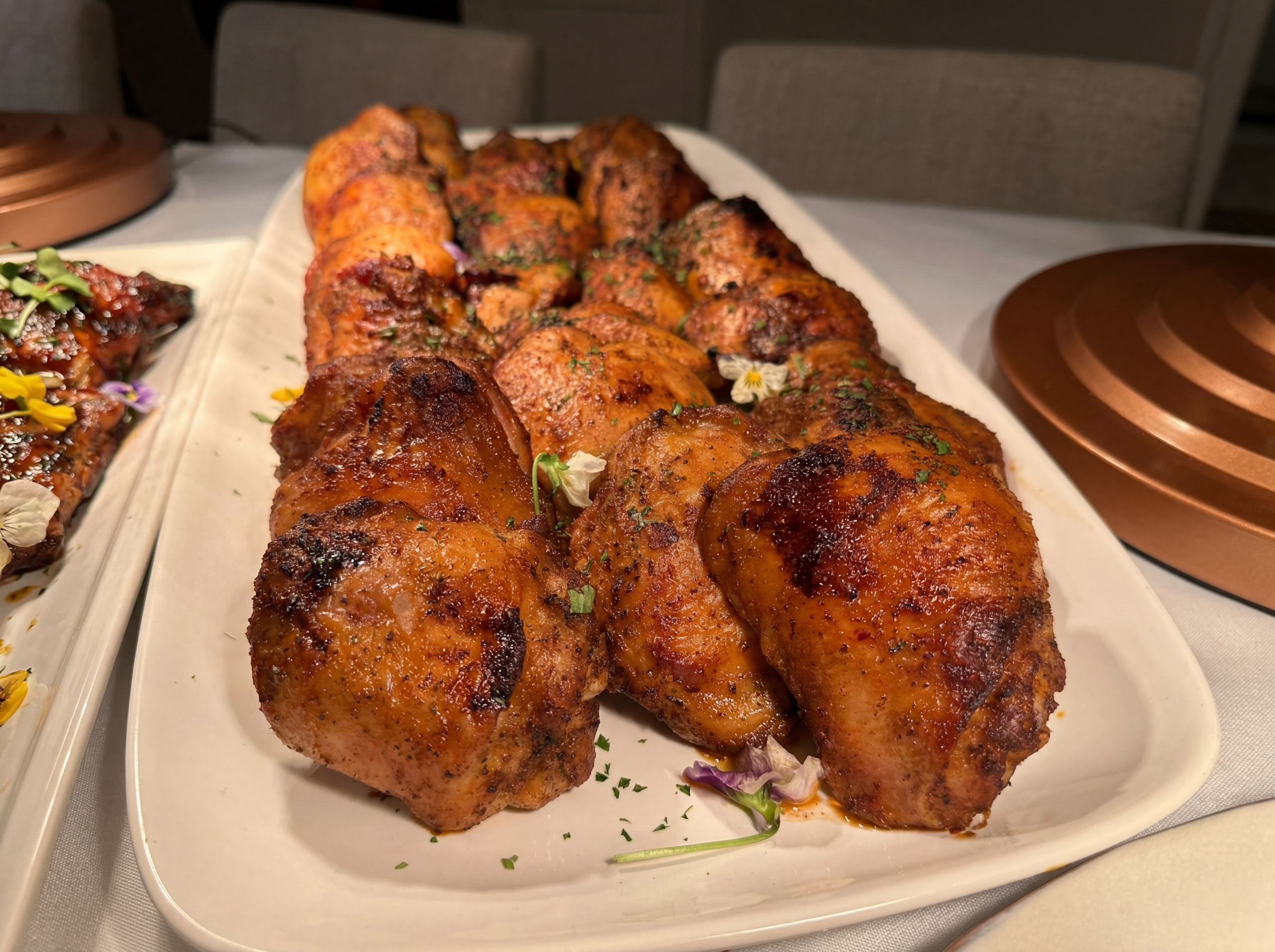
Arrange the thighs skin-side up on a long white ceramic platter or a wood board. Drain the pickled red onions from their brine and scatter generously over the top of the thighs. Reserve a small bowl of extra pickled onions on the side for guests who want more.
A few edible flowers (violas, nasturtium) at the corners of the platter signal that this is intentional plated food, not casual cookout chicken. However, if you do not have edible flowers, skip them. The pickled red onion is doing the visual heavy lifting. In addition, finely chopped parsley over the top adds a subtle green note.
When I brought the platter out to the buffet table, three of the husband’s friends who had been holding out on the sliders went straight for the chicken. One of them said, “I usually skip chicken at a BBQ.” Two minutes later she was back for a second thigh. That is the test for this dish. If chicken-skipping guests come back, you got the wood blend right.
Chef’s Notes for Hickory Smoked Chicken Thighs
Plating
Long white ceramic platter, thighs in a tight row skin-side up. Drained pickled red onions scattered generously over the top. Reserve a small bowl of extra pickled onions on the side. A few edible flowers (violas, nasturtium) at the corners if you have them, otherwise skip. A scatter of finely chopped flat-leaf parsley. For home plating, one thigh per person with extra pickled onion on the side.
Wine and Beverage Pairing
A medium-bodied California Chardonnay (not oaked-out, more like a Sonoma Coast style) holds up to the smoke and meanwhile balances the pickled onion. For a red, a chilled Beaujolais or a light Pinot Noir from the Willamette Valley. The smoke is not aggressive on these thighs, so the wine does not have to fight back. Beer: a clean Pilsner or a German Helles. Save the hop-forward IPAs for a different dish.
Prep Ahead
The pickled red onion holds two weeks refrigerated. Meanwhile, the hickory rub holds two weeks airtight. As for the thighs, they’re best rubbed the day of or the night before, not earlier (the salt starts to break the surface texture past 24 hours of rest, and the skin can go soggy).
Scaling Hickory Smoked Chicken Thighs for Service
Each thigh is one generous serving. For 12 guests, 12 thighs (a 22-inch pellet smoker holds 10 to 12 comfortably with space between). For 20 guests (the original event scale), 20 thighs, smoked in two batches of 10 (stagger by 15 minutes so the second batch finishes during the plating window).
In addition, the hickory rub scales linearly. The pickled onion can scale up but stays in proportion to the platter. As a result, the work at higher counts is mostly batching and plating logistics, not rub or brine math.
If you are planning a full event around this, the Dinner Party Dossier walks the full timing and staging playbook for 8 to 20 person dinners.
Swaps and Substitutions
Boneless skinless thighs cook in 45 minutes to an hour and lose the skin crisp finish; consequently, flavor still works but texture suffers. Drumsticks at 250°F take about the same time as thighs and work with the same rub. Whole chicken halved butterflied works but takes 3 to 4 hours. Similarly, the wood blend can flex: peach or pecan instead of apple, never mesquite or pure hickory (too aggressive at chicken’s fast smoke absorption rate). For example, if you only have cherry pellets, run straight cherry, the smoke will be slightly more tart but still clean. If you only have apple, the smoke will be milder but the rub carries the dish. For a different protein direction entirely, the jerk chicken skewers are the other smoked chicken dish in the archive, built around a Caribbean spice profile instead of Carolina hickory.
If you cooked this, hit reply and tell me how the skin came out. The 400°F finish (or the broiler alternative) is the move most home cooks skip. I read every email.
Want the other two recipes from this same Newport BBQ (the St. Louis ribs with apple cider glaze and the Carolina pulled pork sliders)? Sign up for Recipe Drops. One recipe a week from a real Partum Events event, straight to your inbox.
Planning your own dinner party? The Dinner Party Dossier is the staging playbook I use for 8 to 20 person events. Timing, prep order, the small details that hold a night together.
Hosting at a Newport rental and want me to run it instead of you? Partum Events books private chef BBQs through the summer.
Case No. 029
[WPRM_SHORTCODE_HERE]
Case No. 029
Hickory Smoked Chicken Thighs with Pickled Red Onion
Ingredients
Method
- Pack the sliced red onion (1/8 inch thick, or mandoline #2 setting) into a pint or 1-quart heatproof jar, pressing down to fit.
- Bring apple cider vinegar, water, sugar, salt, peppercorns, and bay leaf to a simmer in a saucepan, whisking until sugar and salt dissolve fully.
- Pour the hot brine over the onions. Press them down with a spoon to fully submerge. Cool to room temperature, then refrigerate at least 2 hours, ideally overnight.
- Whisk brown sugar, kosher salt, smoked paprika, sweet paprika, black pepper, garlic powder, onion powder, dry mustard, cumin, cayenne, coriander, and celery seed in a bowl until evenly combined.
- Pat the thighs completely dry with paper towels. Trim any large flaps of excess skin or loose fat, but keep the skin intact across the meat.
- Brush each thigh lightly with olive oil on both sides. Season with about 1 teaspoon of rub per thigh on the outside, plus another 1/2 teaspoon under the skin (loosen the center skin pocket with your fingers first).
- Arrange on a sheet pan skin-side up, cover loosely, and refrigerate at least 4 hours, ideally overnight.
- Heat smoker to 250°F. Wood blend: 60% cherry, 40% apple. NO pure hickory wood. The hickory backbone is already in the rub.
- Place thighs skin-side up directly on the grates with about 2 inches of space between each. Smoke 1.5 to 2 hours, until internal temperature at the thickest part (not touching bone) reads 175°F.
- METHOD 1 (preferred if your smoker hits 400°F): Bump the smoker temperature to 400°F. Leave thighs skin-side up for 5 to 7 minutes until the skin tightens and turns deep gold-brown. The meat is already cooked internal; you are only crisping the surface.
- METHOD 2 (if your smoker caps below 400°F): Finish skin-side down on a hot grill or under a high broiler for 2 to 3 minutes. Watch closely. Chicken skin goes from crisp to burnt in seconds at broiler heat.
- Rest 5 minutes off the heat before serving.
- Arrange thighs skin-side up on a long white ceramic platter or wood board.
- Drain pickled red onions from the brine and scatter generously over the top of the thighs.
- Garnish with finely chopped flat-leaf parsley. Add a few edible flowers at the corners if you have them. Reserve a small bowl of extra pickled onions on the side.
Notes
Evidence File
Loved this? The Evidence File has 3 more just like it.
A downloadable date-night menu from my private chef archive. Three courses, timed for a home kitchen, plated like the real thing.
Open the Evidence File — $14Did You Make This?
Rate this recipe.
If this recipe made it to your table, tap a star. It helps other home cooks find it.
Classified Access
Get the recipes before they’re public.
New case files. Chef’s notes. The stuff I don’t post anywhere else. Delivered weekly.