Carolina Pulled Pork Sliders Recipe
Carolina pulled pork sliders, served at a sixtieth birthday BBQ on the first weekend of May at a Newport vacation rental the family had taken for the weekend.
Some links in this post are affiliate links. If you buy through them, I may earn a small commission at no cost to you. I only recommend gear I actually use in my private chef kitchen.
Twenty guests, outdoor patio, drinks in hand, no one wanting to sit down yet. The wife had planned the menu around her husband’s favorite dishes. He grew up on Carolina BBQ, the way his dad used to make it. So I built the sliders to be the cocktail-hour anchor of the table, alongside the St. Louis ribs with apple cider glaze and the hickory smoked chicken thighs, the other two dishes from that same night.
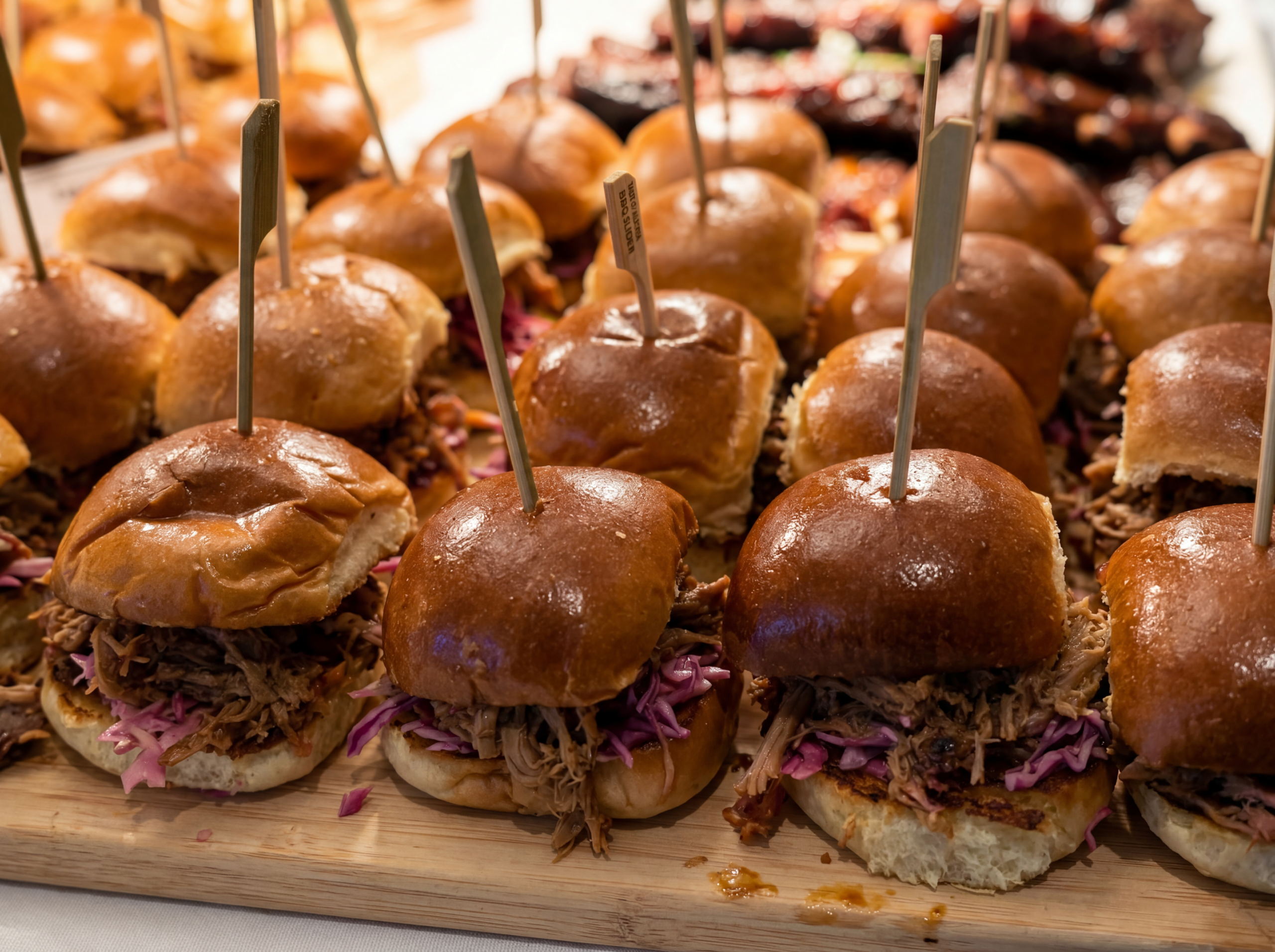
Carolina pulled pork sliders are the BBQ format I default to whenever the brief is “let guests stay on their feet.” One bite, one hand, no plate. Brioche bun, two ounces of vinegar-tanged pulled pork, a pinch of pickled slaw on top, served on a wood board with bamboo picks holding everything together.
This is a two-day cook, but the smoke itself is daytime. The pork rub goes on Thursday night. Friday or Saturday morning, you make the BBQ sauce and start the pickled slaw. The actual smoke runs Saturday morning into late afternoon, seven to nine hours on a four-pound shoulder. If you’ve never smoked a pork shoulder, this is the right first one. It is the most forgiving cut on a smoker. The window for “done” is wide and the cut is hard to overcook.
💡 Plan Your Day: Thursday night rub the pork. Friday afternoon make the BBQ sauce and start the pickled slaw. Saturday 7am pull the pork from the fridge to take the chill off. 8am pork on the smoker. 3pm to 5pm internal temp hits 203°F (depends on your specific shoulder). Wrap, rest in cooler 1 hour. Pull the meat. Toast buns, assemble sliders. Serve by 6pm.
Why This Carolina Pulled Pork Sliders Recipe Works
Most pulled pork slider recipes lean on slow-cooker shortcuts or thick tomato-based BBQ sauce. This one is the opposite. It is a real smoke and a real Carolina vinegar sauce, scaled for an event but cookable at home.
The Carolina Vinegar Sauce Style Behind These Sliders
Carolina BBQ comes in two regional styles. Eastern Carolina is vinegar-forward with no tomato. Western Carolina (which is what this recipe is) adds a little ketchup and brown sugar to round it out without taking over. As a result, the acid keeps the rich pulled pork from feeling heavy after two sliders. That balance is what makes Carolina-style work at a cocktail-hour scale where guests reach for a third and a fourth bite. South Carolina, by contrast, is mustard-based. Different sauce entirely. The Swaps section at the bottom covers that variation if you want to lean that direction.
Why Pickled Slaw Holds Up Better on Pulled Pork Sliders
The slaw is pickled, not creamy. For example, mayo-based slaw on a slider goes soggy in fifteen minutes and the bottom bun turns to paste. In contrast, a vinegar-and-celery-seed brine on shredded cabbage gives you a crisp, tangy crunch that holds up against warm pork for an entire cocktail hour. The colors also pop. Bright purple and pink against the deep mahogany pork. As a result, the plate reads like an event, not a casual cookout.
Brioche and Wood Blend for Carolina Pulled Pork Sliders
The brioche matters. Sweet, lightly enriched, sturdy enough to hold the pork weight without disintegrating. King’s Hawaiian rolls work but they are sweeter and softer; consequently, the bottom bun gives out faster. A toasted brioche bun, brushed with butter cut-side and griddled for thirty seconds, is the right structural choice for a 24-slider buffet pass.
The wood blend is sixty percent hickory, forty percent apple. Hickory is the Carolina backbone. Meanwhile, apple smooths the long cook and pulls fruit notes through the bark over seven to nine hours. Pure hickory on a multi-hour cook can edge toward bitter; therefore, the apple keeps the smoke clean.
What You Need for Carolina Pulled Pork Sliders
The Pork, Rub, and Sauce Pantry
Bone-in pork shoulder. A 4-pound shoulder for 8 servings (about 24 sliders at 2 to 3 ounces of meat each, which works out to 3 sliders per serving). Look for fat marbling through the meat, not just on the white fat layer on the outside. That outside layer is called the fat cap, and it sits on one side of the shoulder. The fat cap is the side that goes UP on the smoker, so the rendered fat bastes the meat as it cooks. Whole Foods, Hannaford, and most full-service meat counters carry bone-in pork shoulder year-round. In addition, bone-in cooks more evenly and yields better than boneless.
Light brown sugar, kosher salt, smoked paprika, black pepper, garlic powder, onion powder, dry mustard, cayenne. The dry rub. Brown sugar caramelizes during the long smoke and builds the bark. Smoked paprika carries the wood note. The rest is balance.
Apple cider vinegar. Two cups total across the BBQ sauce, the spritz, and the slaw brine. Buy the half-gallon jug. You will use it across the trilogy.
Ketchup, Worcestershire, Dijon, hot sauce, red pepper flakes. The BBQ sauce supporting cast. The hot sauce is yours to pick. I use Crystal because it is vinegar-forward and matches the Carolina profile. Tabasco works too; Frank’s RedHot is acceptable in a pinch.
Slaw, Buns, and Build for Carolina Pulled Pork Sliders
Green cabbage, carrot, red onion. For the slaw. Buy the cabbage whole and shred fresh on a mandoline or with the slicer disc of a food processor. Pre-shredded bags go limp inside an hour after dressing.
Celery seed and yellow mustard seed. Both go into the slaw brine. Whole, not ground. They float in the brine and, similarly, bloom slowly over the four-hour pickle.
24 slider-size brioche buns. For 24 sliders at 3 per person. Buy 28 to 30 to account for the occasional bun that splits during toasting. The brand I keep going back to is St. Pierre. Pepperidge Farm slider rolls work too. Both are sturdy enough for the pork weight.
Unsalted butter. Three tablespoons, melted. For brushing the buns before they hit the griddle. Bamboo skewer picks for serving (the kind with the flat paddle top) to hold each slider together for the buffet pass.
Smoker and Tools for Pulled Pork Sliders
A pellet smoker that holds 225°F steady for nine hours. The Weber Smoque XL 34″ pellet smoker is the one I run for private events. Load a full hopper at the start. A pork shoulder over nine hours will burn through pellets and the last thing you want is to walk out at hour seven and find an empty hopper.
A leave-in probe thermometer. Nine hours is too long to rely on instant-read alone. The Chef iQ Sense Gen3 wireless probe lets me monitor the internal temp from inside the kitchen without opening the smoker. WiFi alerts when the meat hits target. A $15 instant-read works if you stay close and check every 30 minutes after hour five, but the wireless is the real win on a long cook.
A spray bottle for the spritz. Apple cider vinegar plus water, equal parts. The HappyAlley spritzer and brush set is what I keep in the BBQ kit, with a basting brush and marinade injector that I use across long cooks like this one.
A small saucepan for the BBQ sauce and the slaw brine. Heavy-duty foil for the wrap and rest. A large heatproof bowl for the slaw. A 1-quart container for storing the BBQ sauce.
How to Make Carolina Pulled Pork Sliders
I started Saturday morning. The pork shoulder had been resting in the fridge for thirty-six hours with the rub on, and I pulled it out at seven to bring it toward room temperature while the smoker came up to 225°F. The Newport rental had a covered side patio, which kept the smoker out of weather and within sight from the kitchen window.
Make the Slaw Brine and the BBQ Sauce
These both keep for two weeks and benefit from sitting. Therefore, I made them Friday afternoon, a full day before the smoke.
The BBQ sauce is a fifteen-minute project. Apple cider vinegar, ketchup, brown sugar, Worcestershire, Dijon, hot sauce, red pepper flakes, salt, black pepper in a saucepan. First, bring to a gentle simmer over medium heat. Cook six to eight minutes until slightly thickened. The sauce should still pour easily, not coat a spoon thickly. Carolina BBQ is meant to be loose and to soak into the pork, not sit on top of it.
Cool to room temp, transfer to a quart jar or squeeze bottle, refrigerate. Meanwhile, the flavor deepens overnight.
💡 Make the BBQ Sauce Ahead: Carolina vinegar sauce tastes raw and sharp the day you make it. Twenty-four hours in the fridge mellows the acid and lets the brown sugar dissolve fully. Make it the night before at minimum, two days ahead if you can.
For the slaw, shred the cabbage and carrot fine on a mandoline (set to about 1/8 inch) or with the slicer disc of a food processor. Then slice the red onion thin. Pile all three in a large heatproof bowl.
Meanwhile, in a saucepan, bring apple cider vinegar, water, sugar, salt, celery seed, and yellow mustard seed to a simmer, whisking until the sugar and salt fully dissolve. Pour the hot brine over the cabbage mixture. Toss thoroughly. Then press down with the back of a spoon to submerge as much as possible. Finally, cover and refrigerate at least four hours, ideally overnight.
The cabbage will release water as it pickles. As a result, the volume in the bowl will drop by about a third. That is the pickle working.
Rub and Smoke the Pork Shoulder
Mix and Apply the Carolina Rub
The night before the cook (Thursday for a Saturday smoke), whisk the rub. Kosher salt, brown sugar, smoked paprika, black pepper, garlic powder, onion powder, dry mustard, cayenne. Importantly, no coriander or cumin for Carolina-style pulled pork. The simplicity is the point. Therefore, the sauce does the seasoning work after the cook.
Pat the pork shoulder completely dry. Find the fat cap (the white layer of fat on one side of the shoulder) so you know which side is which. Then rub the spice blend over every surface of the shoulder, fat cap included. Press it into the seams between the muscles. Finally, wrap tightly in plastic and refrigerate at least twenty-four hours, up to forty-eight.
💡 Long Rub Rest = Deep Flavor: Pork shoulder is dense. The rub needs at least twelve hours to penetrate past the surface. Twenty-four is the target. Forty-eight is fine. Less than twelve and you get seasoning on the outside but bland meat at the center.
Smoke at 225°F for Seven to Nine Hours
An hour before the cook, pull the shoulder out of the fridge and let it come toward room temperature.
Meanwhile, heat the smoker to 225°F. Wood blend: sixty percent hickory, forty percent apple. Then combine the spritz ingredients (apple cider vinegar plus water, equal parts) in a spray bottle.
Hours One Through Three
Place the pork shoulder fat-side up directly on the smoker grates or on a wire rack set in a sheet pan to catch drippings. Smoke undisturbed for the first two hours. After hour two, spritz every hour for the rest of the cook. As a result, the spritz keeps the surface tacky and helps the smoke continue to bind.
Hours Four Through Nine: Stall, Probe, and Pull
In total, this cook runs seven to nine hours for a four-pound shoulder. The rule of thumb is one and a half to two hours per pound at 225°F. The internal temperature target is 203°F at the thickest part, not touching bone. Importantly, a probe should slide through cleanly with no resistance. In addition, the bark should be deep mahogany.
💡 The Stall Is Real: Around hours three to five, when the internal temperature hits about 165°F, the meat will plateau for one to three hours while the connective tissue renders. This is normal. Do not panic, do not bump the smoker temp. Spritz, close the lid, wait. The stall breaks on its own. On a four-pound shoulder, expect the stall to start around hour four.
When the shoulder hits 203°F and the probe slides through, pull it. Wrap the whole shoulder tightly in heavy foil. Then set it in a cooler with towels packed around it, or in a 170°F oven, for one hour to rest. The rest is non-negotiable. As a result, the meat finishes carrying over and the connective tissue settles so the meat pulls clean instead of in stringy clumps.
Pull and Sauce the Pork
After an hour of rest, unwrap. The shoulder will look almost liquid through the bark. As a result, that is rendered fat and gelatin, exactly what you want.
Then pull the meat apart by hand or with two forks. Discard the bone and any large pockets of unrendered fat. The meat should fall apart with almost no pressure. However, if you have to work at it, give it another twenty minutes wrapped and try again.
Finally, toss the pulled meat with about one cup of the Carolina BBQ sauce. Not all of it. You want the meat coated and glossy, not drowning. For example, if you are unsure, start with three quarters of a cup, taste, add more in two-tablespoon increments. Reserve the rest of the sauce in a squeeze bottle for the slider assembly and for extra on the side.
Assemble the Sliders
Just before service, brush the cut sides of the brioche buns lightly with melted butter. Toast cut-side down on a hot griddle (medium-high heat) or in a dry cast-iron pan for thirty seconds, just until golden. Toasted buns hold up better against the warm sauced pork. In contrast, untoasted buns soak through and the slider falls apart in the hand.
On each bottom bun, pile two to three ounces of sauced pulled pork. Top with about one tablespoon of well-drained pickled slaw (a generous pinch, packed loosely). Cap with the top bun. Skewer with a bamboo pick to hold everything together for the pass.
Arrange the assembled sliders on a wood board or platter. Reserve a squeeze bottle of extra BBQ sauce on the side for guests who want more.
When the host’s wife brought the board out to the patio, the guests were already drifting toward the smoker smell. The husband took the first one and ate it standing up at the railing. He had to sit down to eat the second one. By the time the board was empty, three of his oldest friends were lined up at the buffet table waiting for the next round.
Chef’s Notes for Carolina Pulled Pork Sliders
Plating
Long wood board with sliders arranged in tight rows, bamboo picks holding each one together. A small bowl of extra BBQ sauce on the side. Reserve a separate small bowl of extra pickled slaw for guests who want more. For home plating, three sliders per person on a small plate with a side of slaw.
Wine and Beverage Pairing
Carolina pulled pork is hard on wine. The vinegar acid fights tannins and meanwhile the smoke covers up subtle reds. A lighter California Zinfandel from Lodi or Paso Robles works (lower tannin, more fruit). For white, an off-dry Riesling holds up to the vinegar. Beer is the easier call: a malty amber ale, a brown ale, or a Carolina-style sweet tea if anyone is not drinking.
Prep Ahead
The dry rub is a make-as-needed item, but the BBQ sauce and pickled slaw both hold two weeks in the fridge and improve with time. The pork can be smoked, pulled, and held wrapped tight in foil at 170°F (covered, with a splash of the reserved pan jus to prevent surface drying) for up to two hours before service, or pulled and refrigerated up to three days ahead, then re-warmed in a covered pan with a splash of broth.
Scaling Carolina Pulled Pork Sliders for Service
For 12 guests: 1.5x everything, one 6-pound shoulder, smoke time 9 to 12 hours, so start at 6am for an early dinner. For 20 guests (the original event scale): 7 to 8 pound shoulder yields about 4 pounds of pulled meat, which is 32 sliders at 2 oz each (1.5 to 2 per guest in a multi-protein spread). Smoke time 11 to 16 hours.
The 20-guest cook is the only one I recommend starting the night before (10pm Friday for Saturday dinner) for advanced cooks who have a covered outdoor smoker location, a wireless probe with low-pellet alarm, and the ability to check every few hours. In addition, most pellet smokers fit one shoulder. For two shoulders side-by-side, you need a 22-inch grate or larger.
Smoke times scale by weight not by count: an 8 lb shoulder takes 12 to 16 hours at 1.5 to 2 hr per pound, not double a 4 lb cook. As a result, plan the start time accordingly. If you are planning a full event around this, the Dinner Party Dossier walks the full timing and staging playbook for 8 to 20 person dinners.
Swaps and Substitutions
Boston butt and pork shoulder are the same cut sold under different names. Either works. For example, King’s Hawaiian rolls if you cannot find brioche slider buns; the bun is sweeter and softer so use only two ounces of meat per slider. For a mustard-based Carolina sauce (South Carolina style instead of Western Carolina), swap half the vinegar for yellow mustard and drop the ketchup to two tablespoons. Similarly, the wood blend can flex, peach or pecan as the apple substitute, never mesquite (too aggressive for the long cook). If you want a different protein direction entirely, the Cinnamon Spiced Lamb Lollipops are the other passed-appetizer-style dish in the archive, also built for cocktail hour.
If you cooked this, hit reply and tell me how the stall broke. That is the moment that decides the whole cook. I read every email.
Want the next two recipes from this same Newport BBQ (the St. Louis ribs with apple cider glaze and the hickory smoked chicken thighs)? Sign up for Recipe Drops. One recipe a week from a real Partum Events event, straight to your inbox.
Planning your own dinner party? The Dinner Party Dossier is the staging playbook I use for 8 to 20 person events. Timing, prep order, the small details that hold a night together.
Hosting at a Newport rental and want me to run it instead of you? Partum Events books private chef BBQs through the summer.
Case No. 028
[WPRM_SHORTCODE_HERE]
Case No. 028
Carolina Pulled Pork Sliders with Tangy BBQ and Pickled Slaw
Ingredients
Method
- Combine apple cider vinegar, ketchup, brown sugar, Worcestershire, Dijon, hot sauce, red pepper flakes, salt, and black pepper in a saucepan over medium heat. Bring to a gentle simmer and cook 6 to 8 minutes until slightly thickened. Cool, transfer to a jar or squeeze bottle, refrigerate.
- Pile shredded cabbage, carrot, and red onion in a large heatproof bowl. Bring apple cider vinegar, water, sugar, salt, celery seed, and mustard seed to a simmer in a saucepan, whisking until sugar and salt dissolve.
- Pour hot brine over the cabbage mixture. Toss thoroughly. Press down with a spoon to submerge. Cover and refrigerate at least 4 hours, ideally overnight.
- Whisk salt, brown sugar, smoked paprika, black pepper, garlic powder, onion powder, dry mustard, and cayenne in a small bowl.
- Pat the pork shoulder completely dry. Locate the fat cap (the white fat layer on one side of the shoulder). Rub the spice blend over every surface, pressing into the fat cap and seams between muscles. Wrap tightly in plastic and refrigerate at least 24 hours, ideally 36, up to 48.
- Pull the pork from the fridge 1 hour before cooking. Heat smoker to 225°F. Wood blend: 60% hickory, 40% apple. Combine spritz vinegar and water in a spray bottle.
- Place pork shoulder fat-side up directly on the grates or on a wire rack in a sheet pan. Smoke undisturbed for the first 2 hours, then spritz every hour for the rest of the cook.
- Cook 7 to 9 hours (1.5 to 2 hours per pound at 225°F) until internal temperature at the thickest part (not touching bone) reaches 203°F and a probe slides through cleanly with no resistance. Bark should be deep mahogany.
- Wrap the whole shoulder tightly in heavy foil. Rest in a cooler with towels packed around it, or in a 170°F oven, for 1 hour.
- Unwrap. Pull the meat apart by hand or with two forks, discarding the bone and any large pockets of unrendered fat.
- Toss the pulled meat with about 1 cup of the Carolina BBQ sauce. Start with 3/4 cup, taste, add more in 2 tbsp increments until the meat is coated and glossy but not drowning. Reserve the rest in a squeeze bottle for assembly and serving.
- Brush cut sides of brioche buns lightly with melted butter. Toast cut-side down on a hot griddle (medium-high heat) for 30 seconds, just until golden.
- On each bottom bun, pile 2 to 3 oz of sauced pulled pork. Top with about 1 tbsp of well-drained pickled slaw (a generous pinch, packed loosely). Cap with top bun. Skewer with a bamboo pick.
- Arrange on a wood board or platter. Serve with extra BBQ sauce and extra slaw on the side.
Notes
Evidence File
Loved this? The Evidence File has 3 more just like it.
A downloadable date-night menu from my private chef archive. Three courses, timed for a home kitchen, plated like the real thing.
Open the Evidence File — $14Did You Make This?
Rate this recipe.
If this recipe made it to your table, tap a star. It helps other home cooks find it.
Classified Access
Get the recipes before they’re public.
New case files. Chef’s notes. The stuff I don’t post anywhere else. Delivered weekly.